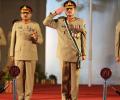
Vice Admiral K Swaminathan highlights concerns over Pakistan's arms procurement and China's growing assertiveness in the Indian Ocean Region.

The local administration denied the rumours about aerial strikes by the Pakistani fighter jets on the compound, saying the explosives used in bomb making exploded, causing the death of 24 people, including 14 militants.

The ministry of external affairs also seemed to reject Trump's forceful comments that Washington brokered the understanding between India and Pakistan on ending their four-day military conflict.
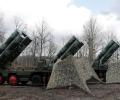
India successfully intercepted or neutralized all Pakistani missiles and drones that targeted 15 Indian cities on Wednesday night, according to official sources. The attack, which was launched in response to India's Operation Sindoor, involved the deployment of Barak-8 missiles, S-400 Triumph air defense systems, Akash surface-to-air missiles, and indigenously developed anti-drone equipment. India retaliated with precision strikes on Pakistani territory, destroying an HQ-9 air defense unit in Lahore and damaging key radar infrastructure. The incident highlights the strength of India's air defense capabilities and its ability to project power with surgical precision.

The Indian Army has released a booklet on Operation Sindoor, which was launched to avenge the April 22 ghastly Pahalgam attack in which Pakistan-backed terrorists brutally killed 26 civilians, mostly tourists, and left many injured.

The delegations from the US and Iran head to Islamabad on Friday, carrying a ceasefire that is already fraying, a Strait that is technically open and practically closed, and a negotiating agenda that would challenge even parties actually negotiating in good faith, which these groups are not. Prem Panicker continues his must read blog on the Iran War.
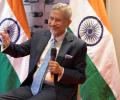
'As far as I'm concerned, how effective the Rafale was or frankly, how effective other systems were -- to me, the proof of the pudding is the destroyed and disabled airfields on the Pakistani side'

'The next two to three weeks will not be decided in Washington.' 'They will be decided in Tehran, in whatever calculation Iran makes about the costs of continued resistance against the costs of appearing to have yielded.'
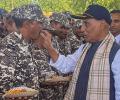
India on Friday called on the International Monetary Fund (IMF) to reconsider its $1 billion assistance to Pakistan, suggesting that Islamabad could use it for terror funding.

'Pakistan's is the only military-controlled nuclear weapons programme in the world.' 'As people get radicalised, the risk of a brigadier or pilot taking matters into their own hands is a real concern.'
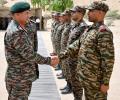
The army chief reviewed the joint operations carried out by the Indian Army, Indian Air Force and Border Security Force in response to Pakistani drone and military attacks that followed India's retaliatory strike on May 7 for the horrific Pahalgam terror attack.

At least a dozen Pakistani military aircraft including F-16 jets were destroyed or damaged in Indian strikes during Operation Sindoor, Chief of Air Staff Air Chief Marshal A P Singh said on Friday while describing Islamabad's claim of India's losses as "fanciful stories".
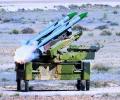
'When one air force (India's) hits the other's airbases with impunity and that air force (Pakistan's) is not able to respond, then the air force, which has put the other's airbases out of commission, has won.'

'I eagerly await the day when we can experience a truly great Bollywood movie rooted in pure historical facts, one that authentically showcases the essence of our armed forces for Indian audiences,' notes Air Commodore Nitin Sathe (retd).
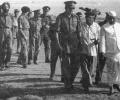
In what was perhaps the most critical meeting before full-scale war broke out, Shastri defined India's immediate war objectives to his defence minister, army, and air force chiefs: 'To defend against Pakistan's attempts to grab Kashmir by force and to make it abundantly clear that Pakistan would never be allowed to wrest Kashmir from India; To destroy the offensive power of Pakistan's armed forces...' A fascinating excerpt from Shiv Kunal Verma's must-read 1965: A Western Sunrise India's War With Pakistan.

Even as Pakistan and Afghanistan gear up to meet in Doha on Saturday to broker a peace after days of fighting and air strike the Taliban government said that Afghanistan reserves the right to respond to Pakistani airstrikes on its land.

India's Foreign Secretary Vikram Misri said on Thursday that the choice of de-escalation is with Pakistan, as India only responded to the April 22 Pahalgam terror attack, which killed 26 people. He added that Pakistan has been escalating the situation with cross-border terrorism against India for decades.
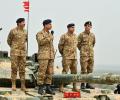
'Can a nuclear-armed nation sustain itself indefinitely under overt military rule without catastrophic consequences for itself and the region? History suggests otherwise.'

Even Prime Minister Narendra Modi told US Vice President JD Vance on May 9 that Indian response will be "more forceful, stronger, devastating" in response to Pakistani actions, the sources said.

Air Marshal Narmdeshwar Tiwari reveals details of Operation Sindoor, claiming IAF strikes forced Pakistan to request an end to hostilities.

India on Sunday said it inflicted tremendous losses to the Pakistan military, including downing its fighter jets featuring latest technologies and damaging key military installations close to even capital Islamabad, during the three-day confrontation between the two sides.
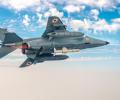
India's precision strikes using an array of weapon systems and missiles on eight key installations ranging from air defence systems to radar sites and command centres of the Pakistani military forced Islamabad to urge New Delhi to end the hostilities, the sources said.

India's recent missile strikes on nine terrorist locations in Pakistan and Pakistan-occupied Kashmir (PoK), including Bahawalpur, mark a significant escalation in the long-standing military tensions between the two nations. This article provides a historical overview of the Indo-Pak military confrontations, tracing their roots back to the 1947 war following India's independence and the partition of the sub-continent, and highlighting key conflicts such as the 1965 war, the 1971 Bangladesh Liberation War, the 1999 Kargil War, the 2016 Uri attack, and the 2019 Pulwama attack.
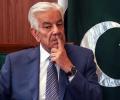
The entry of other Arab countries in the mutual defence deal between Pakistan and Saudi Arabia is not ruled out, Defence Minister Khawaja Asif has said, adding that 'doors are not closed' for such developments.
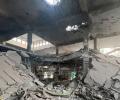
Pakistan is considering creating a new position of 'Commander of Defence Forces' (CDF) to improve coordination and unified command among its military services, according to media reports. The move is part of broader defence reforms and is reportedly influenced by recent conflicts and the evolving nature of modern warfare.

'Should China's interest in the Teesta River projects be approved, it would likely result in heightened Chinese presence near the Siliguri corridor.'
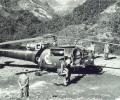
Air Commodore Nitin Sathe discovers how the IAF trained Pakistani air force pilots, during the 1971 War, which led to the birth of the Bangladesh air force.
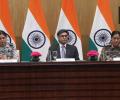
Colonel Sofiya Qureshi revealed that 300 to 400 drones were deployed across 36 locations, with several being shot down by Indian forces using both kinetic and non-kinetic methods.

10 Heroes of the 1965 War which ended on September 23 60 years ago.

A general court martial (GCM) instituted by the Indian Air Force has ordered the sacking of a group captain for the crash of an Mi-17 V5 helicopter in Budgam in Jammu and Kashmir after it was hit by a missile on February 27, 2019, official sources said on Tuesday.
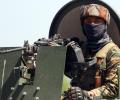
The real heroes of Operation Sindoor were not the armed forces or political leadership, but the ordinary citizens of India who refused to fall into the trap of communal provocation, asserts Colonel Anil A Athale (retd).

In a culture where children take up the profession of their father, her becoming a politician was seen as natural and acceptable.
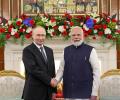
Luckily for us, a Russia that is desperate to stay relevant in an emerging multipolar world finds in India a reliable geostrategic partner. The Russian proximity to India also keeps China from exploiting its economic dominance vis a vis Russia, points out Colonel Anil A Athale (retd).
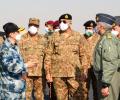
'There is much to glean from such exercises. And make it known that we are ready to take them on together!', says Air Commodore Nition Sathe (retd).

In a stern warning to Pakistan, Army chief General Upendra Dwivedi said on Friday that the neighbouring country should stop sponsoring terrorism on its soil if wants to retain its place on the world map.

From the Sensex firms, Eternal, Mahindra & Mahindra, Maruti, Bajaj Finance, Tata Steel, Bharti Airtel, Bajaj Finserv, Asian Paints, Power Grid and State Bank of India were among the laggards. Kotak Mahindra Bank, Axis Bank, Titan, HCL Tech, Tata Motors, Infosys and Tata Consultancy Services were the gainers.

Maharashtra's elite Anti-Terrorism Squad (ATS) has arrested a Thane-based junior engineer on charges of spying, alleging that he provided sensitive defence information to a Pakistani intelligence operative who honey-trapped him online, officials said on Thursday.

This Asia Cup has charred the relationship between India and Pakistan players.
'You can be sure that the Pakistanis knew when the Indian Air Force aircraft took off, which type these were, and what their likely targets were.' 'The question was: How would they determine that the IAF wanted to fire, and when to bounce them?', notes Shekhar Gupta.
'The devastating Indian Air Force strikes on the night of May 9-10 exposed Pakistan's vulnerabilities.' 'If these had continued, it would have further degraded Pakistan's ability to continue with air operations.'
